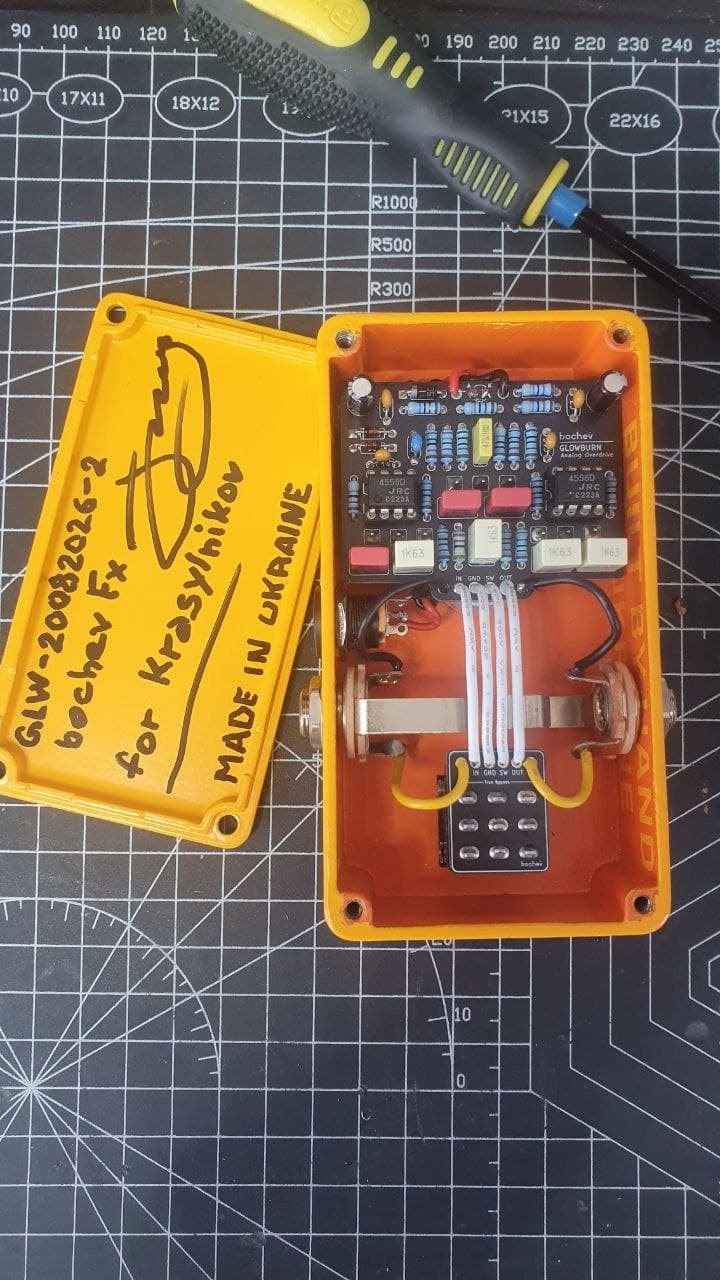
Built by hand. Made to be played.
Bochev FX started with a simple idea:
I wanted something I couldn’t find.
I’ve always loved analog sound — old amplifiers, warm overdrive and circuits that react to the way you actually play.
Alongside that was always an engineering curiosity: understanding why something sounds the way it does, changing it, rebuilding it and eventually creating something of my own.
I built my first pedal about ten years ago because I couldn’t find an existing product that did exactly what I wanted.
There was no business plan.
Just music, electronics and curiosity.
That approach eventually became Bochev FX.
01
Analog by choice
There is already enough digital technology in the world.
I sometimes describe myself as an analog creature stuck in a digital world.
It’s a joke — but it explains a lot about Bochev FX.
For me, analog means:
- character — a circuit with its own personality
- response — something that reacts to your hands
- simplicity — controls that immediately make sense
- connection — between the musician, the instrument and the circuit
A pedal should feel like an instrument, not a computer.
Turn a knob and hear what happens.
Play harder and the circuit reacts.
Roll something back and the sound changes with you.
No screens. No menus. No unnecessary features.
02
It starts with a missing sound
Most Bochev FX pedals begin with one thought:
I want this sound — but I can’t find the pedal I want to make it.
Then the idea starts becoming something physical.
Idea → Circuit → Breadboard → Listening → Design → PCB → Build → Testing
The circuit changes.
Components change.
The enclosure changes.
Sometimes even the original idea changes.
And then the pedal goes to musicians.
Their feedback is one of the most important parts of the process. If something can feel, sound or work better, I go back and change it.
A schematic that works is not enough.
A pedal is finished when musicians want to keep playing through it.
GLOWBURN and SHAPER represent this philosophy especially well.
They grew through experiments, listening and countless small decisions until they became pedals I genuinely feel proud of.
03
Details matter
Sound comes first.
But a great pedal is more than a schematic.
The enclosure matters. The knobs matter. The components matter. The way the controls feel matters. The way everything is assembled matters.
Every Bochev FX pedal is assembled and soldered by hand.
Sometimes I paint parts myself.
And sometimes I simply hold a finished pedal and look at it like a cat that has decided it deserves attention.
That probably explains our attitude to details better than a corporate statement about quality control ever could.
We use quality components even when they cost more.
Not because expensive automatically means better — but because when a better component genuinely improves the result, cutting that corner simply doesn’t make sense to us.
These are not products we make because we have to. These are things we love making.
04
A family behind every pedal
Bochev FX started from my personal obsession with guitar sound and electronics.
But today it is no longer a one-person story.
My wife and my son are directly involved in what we are building.
My daughter, my mother and my sister support the project and are part of its story too.
So when we describe Bochev FX as a small independent workshop, that isn’t marketing language.
There really is a family behind it.
And that is something I want to preserve as the company grows.
The goal is not to become a giant factory producing anonymous boxes.
The goal is to build a modern analog company:
- professional
- technically serious
- independent
- personal
- connected to musicians
A company capable of reaching players around the world without losing the character of a small workshop.
05
Built by hand in Ukraine
Ukraine is not simply a location printed on the bottom of our pedals.
It is part of who we are.
This is my home.
And I want every Bochev FX pedal to carry that identity wherever it goes.
Built by hand in Ukraine means exactly what it says.
Designed here. Assembled here. Tested here.
Made by people who care about what leaves the workshop.
It isn’t a slogan added at the end of the process.
It is part of the brand itself.
06
Made for musicians we understand
When I imagine the person using a Bochev FX pedal, I don’t imagine a marketing demographic.
I imagine myself.
My friends.
And people I haven’t met yet — but might become friends with because we care about the same things.
Guitars. Amplifiers. Pedals. Good sound.
We make pedals for musicians who notice details.
For people who care about the way their equipment sounds, feels and responds.
For someone who understands why a small independent workshop may look at a product differently from a large corporation.
For someone who can still plug a guitar into an amplifier, discover a new sound and unexpectedly keep playing for another hour.
When I see a Bochev FX pedal on someone else’s pedalboard, I want my first thought to be simple:
This musician clearly cares about good sound.